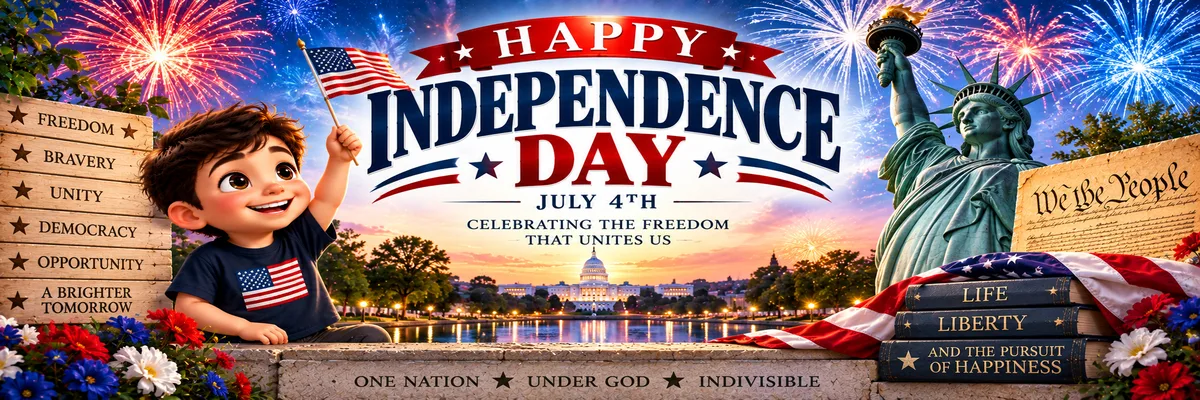
Wednesday, July 4, 2057
The History of Independence Day
Independence Day is celebrated every year on July 4 in the United States. It commemorates the adoption of the Declaration of Independence in 1776, when representatives of the thirteen American colonies formally declared that they were no longer under British rule. Today, we celebrate with fireworks, parades, flags, family gatherings, cookouts, concerts, and enough red, white, and blue decorations to make absolutely sure nobody forgets which country is having a birthday. But July 4 was not actually the day the American Revolution began, and it wasn't the day the United States finally won its independence. The real story is much more interesting. America Was Once Made Up of British Colonies Before there was a United States of America, there were thirteen British colonies along the Atlantic coast of North America. The colonists were subjects of the British Crown. For many years, Britain allowed the colonies considerable freedom to manage their own local affairs. But after the expensive French and Indian War, Britain began imposing new taxes and regulations on the colonies. Many colonists objected. Their complaint was not simply that they disliked paying taxes. They argued that Parliament was taxing them even though the colonies did not have elected representatives there. This helped inspire the famous phrase: "No taxation without representation." Tensions With Britain Grew The disagreement became increasingly serious. Britain passed laws intended to raise revenue and strengthen control over the colonies. Colonists organized protests and boycotts. Events such as the Boston Massacre in 1770 and the Boston Tea Party in 1773 made the conflict even worse. After the Boston Tea Party, Britain responded with harsh measures that colonists called the Intolerable Acts. The colonies increasingly began cooperating with one another. Representatives gathered in the Continental Congress to discuss how they should respond. At first, independence was not necessarily everyone's goal. Many colonists still hoped their problems with Britain could somehow be resolved. Then people started shooting. The American Revolution Begins On April 19, 1775, fighting broke out between colonial militia and British troops at Lexington and Concord in Massachusetts. The American Revolutionary War had begun. The colonies organized the Continental Army and selected George Washington as its commander. Even after fighting started, some Americans still hoped for reconciliation with Britain. But as the war continued, support for complete independence grew. One particularly influential voice was Thomas Paine, whose pamphlet Common Sense, published in January 1776, argued strongly that the colonies should become independent. The idea that once seemed radical was becoming a real possibility. The Colonies Decide to Become Independent In June 1776, Virginia delegate Richard Henry Lee introduced a resolution declaring that the colonies "are, and of right ought to be, free and independent States." Congress appointed a committee to prepare a formal declaration explaining why independence was necessary. The committee included: Thomas Jefferson, John Adams, Benjamin Franklin, Roger Sherman, and Robert R. Livingston. Jefferson wrote the primary draft. The document became the Declaration of Independence. What Did the Declaration Say? The Declaration made an extraordinary argument for its time. It stated that: "all men are created equal" and that people possess rights including: "Life, Liberty and the pursuit of Happiness." It argued that governments receive their legitimate authority from the consent of the governed. And when a government repeatedly violates people's rights, the document argued that people have the right to change or replace that government. The Declaration then listed grievances against King George III and explained why the colonies believed separation from Britain was justified. These ideas would become some of the most famous words in American history. But there was also an enormous contradiction. "All Men Are Created Equal"... But Not Everyone Was Free When the Declaration proclaimed equality and liberty, hundreds of thousands of people were enslaved in the colonies. Women did not possess the same political rights as men. Native American nations had their own governments, territories, and complicated relationships with both Britain and the colonies, while colonial expansion increasingly threatened their lands. Even Thomas Jefferson, the primary author of the Declaration, enslaved people. That contradiction became one of the central struggles of American history. The Declaration described extraordinary ideals. America did not yet live up to them. Over generations, abolitionists, women seeking equal rights, civil rights leaders, workers, immigrants, veterans, activists, and ordinary citizens would repeatedly point back to America's own promises and ask: If these rights belong to everyone, shouldn't they actually belong to everyone? That question helped shape the country long after 1776. So What Actually Happened on July 4? Here comes the part that makes the calendar slightly confusing. On July 2, 1776, the Continental Congress approved the resolution declaring independence from Britain. John Adams actually believed July 2 would become the great American anniversary. He was off by two days. Congress then continued reviewing and editing the Declaration of Independence. On July 4, 1776, Congress approved the final text of the Declaration. That is the date printed on the document and the date Americans eventually chose to celebrate. Was the Declaration Signed on July 4? Not by everyone. This is another popular Independence Day myth. The Declaration was adopted on July 4, but most delegates did not gather around a table and dramatically sign the famous parchment that same afternoon. The formal engrossed copy was prepared afterward, and most delegates signed it on August 2, 1776, with some signatures added later. So July 4 celebrates the adoption of the Declaration, not one giant signing ceremony. Declaring Independence Didn't Make America Independent Overnight Writing a declaration was one thing. Making Britain accept it was something completely different. The Revolutionary War continued for years. American forces suffered terrible defeats and difficult winters, including the famous winter at Valley Forge. France eventually entered the war as an American ally, providing crucial military and financial assistance. In 1781, American and French forces defeated a major British army at Yorktown, Virginia. That effectively ended most major fighting. But the war formally concluded with the Treaty of Paris in 1783. Britain recognized the independence of the United States. Seven years had passed since the Declaration of Independence. Americans Started Celebrating July 4 Very Quickly Americans began commemorating independence even while the Revolutionary War was still being fought. Early celebrations included: Bonfires. Public speeches. Military demonstrations. Music. Bell ringing. Parades. And fireworks. Fireworks therefore aren't some modern addition to the holiday. They became associated with Independence Day very early in American history. John Adams had even predicted that American independence would be celebrated with festivities, illuminations, and public celebrations for generations. He got the date wrong, but he definitely understood Americans. Give us independence and apparently we immediately require fireworks. July 4 Becomes an Official Holiday Independence Day celebrations grew throughout the 19th century. In 1870, Congress made July 4 a federal holiday. It later became a paid federal holiday for federal employees. Over time, Independence Day developed into the nationwide celebration we recognize today. The Statue of Liberty Came Much Later One of America's most recognizable symbols of freedom did not exist during the Revolution. The Statue of Liberty was a gift from France and was dedicated in 1886, more than a century after independence. Its official name is Liberty Enlightening the World. Over time, the statue became associated not only with American independence but also with freedom, democracy, and immigration. For millions of immigrants arriving by ship in New York Harbor, the Statue of Liberty became one of their first sights of America. Independence Day Today Today, July 4 is celebrated across the country. Communities hold parades. Families gather for cookouts. American flags appear everywhere. Military ceremonies honor those who have served. Orchestras perform patriotic music. Children wave flags. And when darkness arrives, fireworks fill the sky. But underneath all the celebration is a remarkable historical idea. In 1776, thirteen colonies declared that legitimate government should ultimately derive its authority from the people and that human beings possess rights government should respect. America has spent the centuries since arguing, struggling, protesting, legislating, fighting, voting, and working over what those promises truly mean and who gets to share in them. That work has never been perfectly finished. Perhaps that is part of what makes Independence Day worth teaching rather than simply celebrating. It gives us an opportunity to remember where the country began, recognize where it failed to live up to its own ideals, appreciate how far it has traveled, and think about what each generation can do next. Because independence is not only a story about something Americans declared in 1776. It is also the continuing responsibility of each generation to protect the freedoms that declaration helped place at the center of the American experiment. Remember the history. Celebrate the freedom. Honor those who protected it. And keep working toward the promise of liberty and opportunity for all.
This date is shown automatically on every calendar — a specific school or district can mark itself open or closed for this holiday from its own settings.
