Friday, June 19, 2048
The History of Juneteenth
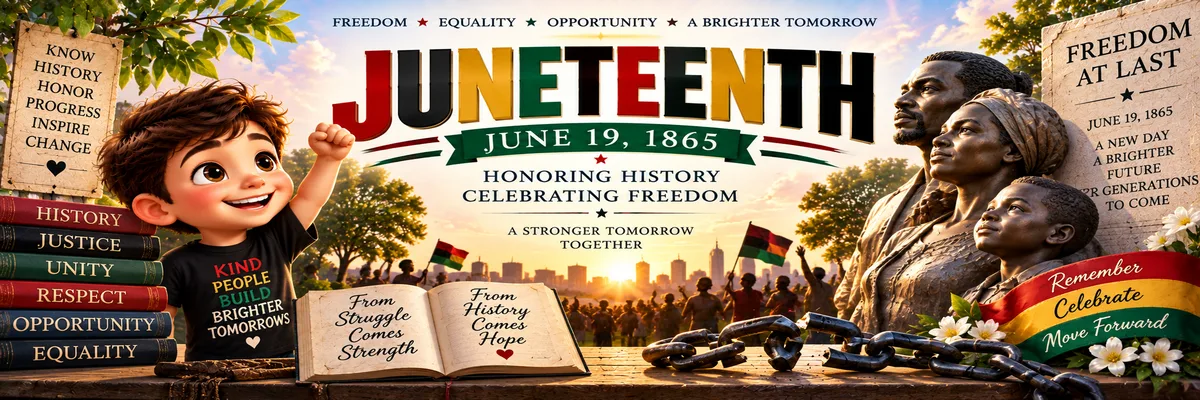
Juneteenth is observed every year on June 19. It commemorates the day in 1865 when Union troops arrived in Galveston, Texas, and announced that enslaved people there were free. Today, Juneteenth is a federal holiday and a celebration of freedom, African American history, family, community, culture, and progress. But there is something important to understand about the date. The Emancipation Proclamation had been issued more than two years earlier. So why did freedom take so long to reach Texas? It Begins With Slavery in America Slavery existed in what became the United States for centuries. Millions of African people and their descendants were enslaved, bought and sold, separated from their families, forced to work without freedom, and denied basic rights. By the 1800s, slavery had become one of the greatest political and moral conflicts in the country. That conflict eventually helped lead to the American Civil War, which began in 1861. Abraham Lincoln and the Emancipation Proclamation On January 1, 1863, President Abraham Lincoln's Emancipation Proclamation went into effect. It declared enslaved people in areas of the Confederacy still in rebellion to be free. But there was a major problem. A proclamation written in Washington could not instantly free every enslaved person throughout Confederate territory. The Civil War was still being fought. The federal government did not control every part of the South, and slavery continued in places where Union authority could not yet effectively enforce emancipation. Texas was one of those places. Why Texas? Because Texas was geographically distant from much of the major fighting, slavery continued there during the war. Some enslavers had even moved enslaved people into Texas during the conflict. By 1865, however, the Confederacy was collapsing. General Robert E. Lee surrendered the Army of Northern Virginia in April. President Lincoln was assassinated only days later. Other Confederate forces surrendered during the following weeks. Then Union forces arrived in Galveston. June 19, 1865 On June 19, 1865, Union Major General Gordon Granger issued General Order No. 3 in Galveston, Texas. The order announced that, in accordance with a proclamation from the executive of the United States, all enslaved people were free. For enslaved people in Texas, this announcement represented an enormous transformation. People who had been legally treated as property were being told that slavery was over. June 19 became the date remembered by generations of Texans as Juneteenth, a combination of the words June and nineteenth. Was June 19 the Day Slavery Ended Everywhere? Not exactly. This is one of the important details sometimes lost when the Juneteenth story is shortened. The Emancipation Proclamation did not itself abolish slavery everywhere in the United States. It applied specifically to areas covered by the proclamation, and slavery remained legally possible in some places outside its reach. The permanent nationwide abolition of slavery came with the 13th Amendment to the United States Constitution. Congress passed the amendment in early 1865, and it was ratified later that year. On December 6, 1865, the 13th Amendment received the necessary state ratifications. It abolished slavery throughout the United States, except as punishment for a crime after conviction. So Juneteenth represents an enormously important moment in the destruction of American slavery, but the larger legal history continued beyond June 19. The First Juneteenth Celebrations The first anniversary celebrations began in Texas in 1866. African American communities gathered for food, music, prayer, speeches, celebrations, and remembrance. Families traveled to be together. People dressed in their finest clothing. Communities celebrated freedom while also teaching younger generations about what had happened. These gatherings were particularly meaningful because newly freed Black Americans were building communities and institutions while facing discrimination and violence. Juneteenth became a way of saying: We remember where we came from, we celebrate our freedom, and we continue moving forward. Emancipation Park During segregation, Black communities were sometimes excluded from public spaces where they wanted to hold celebrations. In Houston, a group of African American community leaders purchased land in 1872 specifically for Juneteenth celebrations. That land became known as Emancipation Park. The park remains an important part of Juneteenth history. It is also a reminder that even after slavery ended, Black Americans still had to fight for access, equality, voting rights, education, economic opportunity, and equal treatment under the law. Freedom did not suddenly make discrimination disappear. Juneteenth Spreads Beyond Texas For many years, Juneteenth was especially associated with Texas. But as African American families moved throughout the United States, particularly during the Great Migration, they carried Juneteenth traditions with them. Celebrations appeared in communities around the country. The Civil Rights Movement also renewed interest in African American history and the continuing struggle for equality. In 1980, Texas became the first state to make Juneteenth an official state holiday. Other states gradually recognized it as well. Juneteenth Becomes a Federal Holiday Juneteenth received much greater national attention during the early 21st century. For decades, activists and community leaders worked to make the holiday nationally recognized. One of the best-known advocates was Opal Lee, a Texas educator and activist who spent years campaigning for federal recognition of Juneteenth. That effort eventually succeeded. In 2021, Congress passed legislation establishing Juneteenth National Independence Day as a federal holiday. President Joe Biden signed it into law on June 17, 2021. Juneteenth became the first new federal holiday established since Martin Luther King Jr. Day was created decades earlier. The Juneteenth Flag Juneteenth also has its own widely recognized flag. The flag uses red, white, and blue, connecting the story of emancipation to the broader American story. Its star represents Texas, the Lone Star State, where Juneteenth began. The bursting outline around the star represents a nova, symbolizing a new beginning. The curved line across the flag represents a new horizon and the opportunities that freedom was supposed to bring. Other celebrations also use the colors red, black, and green, which have broader connections to Black history, identity, and Pan-African traditions. Juneteenth Today Today, Juneteenth celebrations include festivals, historical programs, music, family gatherings, food, parades, educational events, museum programs, community service, and discussions about African American history. But Juneteenth is more than a celebration of something that happened in 1865. It gives us an opportunity to teach an important truth about American history. Freedom can be declared on paper. Making that freedom real can take much longer. The Emancipation Proclamation came in 1863. The announcement in Galveston came in 1865. The 13th Amendment abolished slavery nationally later that year. And the struggle for equal rights continued through Reconstruction, segregation, the Civil Rights Movement, and beyond. That is why Juneteenth can hold both celebration and reflection at the same time. We celebrate people becoming free. We remember the generations who survived slavery. We recognize the people who fought to expand America's promise of liberty. And we teach the next generation that knowing difficult history is not about remaining trapped in the past. It is about understanding how we arrived here and how we can build something better. Remember the history. Celebrate freedom. Honor the progress. Keep building a brighter future together.
This date is shown automatically on every calendar — a specific school or district can mark itself open or closed for this holiday from its own settings.
