Monday, October 14, 2047
The History of Columbus Day / Indigenous Peoples' Day
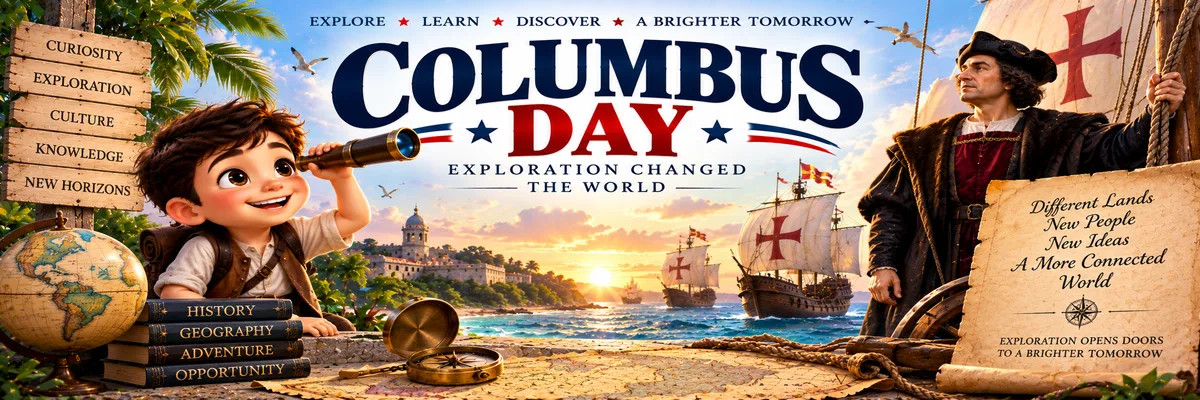
Columbus Day is observed in the United States on the second Monday of October. The holiday traditionally commemorates Christopher Columbus's arrival in the Americas on October 12, 1492. For generations, many Americans learned a very simple version of the story: Columbus sailed across the Atlantic, discovered America, and proved the world was round. The real history is much more interesting, and much more complicated. Columbus did make an extraordinary Atlantic voyage in 1492, but he did not discover an empty continent, he did not reach what is now the mainland United States on that first voyage, and educated Europeans already knew the Earth was round. Millions of Indigenous people were already living throughout the Americas, with their own nations, languages, governments, cultures, trade networks, and histories. So to understand Columbus Day, we have to start before Columbus arrived. The Americas Before Columbus People had lived in the Americas for thousands of years before 1492. By the time Columbus crossed the Atlantic, the Western Hemisphere contained an enormous variety of societies. There were large cities and small communities. People farmed, traded, built governments, practiced religions, created art, studied astronomy, developed sophisticated agricultural systems, and spoke hundreds of languages. Civilizations including the Maya, Mexica, commonly called the Aztecs, and Inca developed complex societies in different parts of the Americas. In North America and the Caribbean, many other Indigenous nations and peoples had their own established communities and political systems. This is important because saying Columbus "discovered America" can make it sound as though nobody was here. They absolutely were. Who Was Christopher Columbus? Christopher Columbus was born in Genoa, in present-day Italy, around 1451. He became an experienced sailor and developed a plan to reach Asia by sailing west across the Atlantic Ocean. European merchants wanted better access to valuable Asian goods such as spices, silk, and other products. Columbus believed sailing west could provide another route. There was one major problem with his calculations. He seriously underestimated the size of the Earth and the distance between Europe and Asia. Had the Americas not existed between Europe and Asia, his expedition would have faced a much longer journey than he expected. Spain Finally Agreed to Support Him Columbus spent years looking for someone willing to finance his voyage. Eventually, the Spanish monarchs Ferdinand II of Aragon and Isabella I of Castile agreed to support the expedition. In August 1492, Columbus departed Spain with three ships: The Niña The Pinta and The Santa María The sailors crossed the Atlantic for more than a month without knowing exactly what they would find. Then, in October, they saw land. October 12, 1492 On October 12, 1492, Columbus's expedition reached an island in the Caribbean. The exact island remains debated by historians, although it was somewhere in what is now the Bahamas. Columbus called the island San Salvador. But the people living there already had their own world and identity. They were part of the Taíno peoples of the Caribbean. Columbus believed he had reached islands near Asia. That is why Europeans later used the word "Indians" for Indigenous peoples of the Americas. It came from a geographical misunderstanding that lasted far longer than Columbus's original mistake. Columbus Never Realized He Had Reached a "New World" Columbus made four voyages across the Atlantic between 1492 and 1504. He explored parts of the Caribbean and reached portions of Central and South America. But Columbus continued believing that the lands he encountered were connected with Asia. He never understood the geography in the way Europeans eventually would. And he was not the first European known to have reached the Americas either. Norse explorers had traveled to North America centuries earlier. Archaeological evidence at L'Anse aux Meadows in Newfoundland confirms a Norse presence around the year 1000. So why is 1492 so important? Because Columbus's voyages began sustained contact between Europe and the Americas on an enormous scale. And that changed world history. The Columbian Exchange After 1492, plants, animals, foods, diseases, technologies, and people began moving between the Eastern and Western Hemispheres at unprecedented levels. Historians call this the Columbian Exchange. Foods originating in the Americas, including potatoes, tomatoes, corn, cacao, and many varieties of peppers, eventually transformed diets around the world. Europeans brought animals and crops including horses, cattle, wheat, and sugarcane to the Americas. This exchange helped transform agriculture, economies, cultures, and populations on both sides of the Atlantic. But there was a devastating side too. Europeans brought diseases such as smallpox to populations that had little or no previous exposure to them. Indigenous communities suffered catastrophic population losses. European colonization also brought warfare, forced labor, displacement, the seizure of Indigenous lands, and the expansion of slavery. So the contact beginning in 1492 connected worlds, but it also produced enormous human suffering. Columbus's Treatment of Indigenous People This is another part of the history that should not be skipped. Columbus's relationship with Indigenous people was not simply a friendly meeting between explorers and local communities. His writings show that he quickly considered how Indigenous people might be exploited. During Columbus's voyages and administration in the Caribbean, Indigenous people were captured, enslaved, forced to work, and subjected to violence. Spanish colonization expanded after Columbus, and Indigenous populations experienced tremendous disruption and suffering from exploitation, warfare, displacement, and disease. That does not mean we need to pretend the voyage itself was historically unimportant. Quite the opposite. It means we should teach the entire importance of it, including what happened to the people who were already there. So How Did Columbus Get a Holiday? Columbus became an important symbol for many Americans centuries after his voyages. One major reason involves Italian American history. During the 19th and early 20th centuries, large numbers of Italian immigrants came to the United States. They often faced severe discrimination, prejudice, and violence. Columbus, an Italian-born historical figure already associated with the American story, became a source of cultural pride for many Italian Americans. One particularly horrific event occurred in New Orleans in 1891, when eleven Italian immigrants were killed by a mob. The incident created an international crisis between the United States and Italy. The following year, President Benjamin Harrison encouraged Americans to observe the 400th anniversary of Columbus's voyage. Columbus celebrations continued growing afterward. Columbus Day Becomes a Federal Holiday In 1937, President Franklin D. Roosevelt proclaimed Columbus Day a national holiday. For years, it was associated with October 12. Then Congress passed the Uniform Monday Holiday Act. Beginning in 1971, the federal observance moved to the second Monday in October. That is where it remains today. Officially, Columbus Day is still a federal holiday. Why Do Some Places Celebrate Indigenous Peoples' Day Instead? As Americans learned more about Indigenous history and the consequences of European colonization, people increasingly questioned whether Columbus should be celebrated as a hero. Some states, cities, school districts, and communities now observe Indigenous Peoples' Day, either instead of Columbus Day or alongside it. Indigenous Peoples' Day recognizes the histories, cultures, contributions, survival, and continuing presence of Native peoples. Other communities continue observing Columbus Day, particularly because of its historical importance to Italian American heritage. And some recognize both. That is why a school calendar may say Columbus Day, Indigenous Peoples' Day, or both, depending on the state or district. Columbus Day Today Columbus Day is a good example of why studying history becomes more interesting when we move beyond the simplest version of the story. Columbus did not prove the world was round. He did not arrive in an empty land. He did not understand that he had encountered continents previously unknown to most Europeans. And his voyages had devastating consequences for Indigenous peoples. But his 1492 voyage was still one of the major turning points in world history. It helped begin sustained interaction between peoples who had developed on opposite sides of the Atlantic for thousands of years. That interaction transformed food, language, religion, trade, migration, politics, disease, warfare, and eventually the entire world. For some Americans, the holiday also represents Italian American heritage and the struggles of immigrants seeking acceptance in the United States. For many Indigenous Americans, the date represents something very different: the beginning of centuries of colonization, displacement, violence, and resistance. Those stories can exist in the same history lesson. We do not have to erase one story to teach another. Learn who was already here. Understand why Europeans crossed the Atlantic. Recognize what changed after 1492. Remember both the achievements and the suffering. History becomes more valuable when we are willing to learn the whole story.
This date is shown automatically on every calendar — a specific school or district can mark itself open or closed for this holiday from its own settings.
